Most Google Ads copy is written in a hurry. You get 15 headline boxes, and whatever comes to mind first goes in. The result is usually 15 versions of the same idea.
The 5 Pillars are how I fix that. It's the framework I teach every coaching student. It's also what I use on every ad I write for my own clients and for the agencies I work with. Each pillar does a different job, so Google gets real variety to work with.
If we've just covered this in a session, jump to the cheat sheet.
The 5 pillars at a glance
- Keyword headlines: match what they searched for.
- Questions: ask the question they're asking themselves.
- USPs: prove why you're the best pick. This is the most important one.
- Urgency: give them a reason to act now, but only when it's true.
- Call to action: tell them what to do next, in as few words as possible.
An easy way to remember them: Match it, Ask it, Prove it, Hurry it, Close it.
1. Keyword headlines
These headlines contain the keyword the ad group targets. When someone searches for a plumber and your headline says plumber, they know straight away they're in the right place. It's also the biggest copy lever on Quality Score, because Google measures how relevant your ad is to the search.
Examples: Plumber · Top-Rated Plumber · #1 Plumbing Company
Include 1 dynamic keyword insertion headline here, like {KeyWord:Plumber}. Google swaps in the keyword from your ad group that triggered the ad, as long as it fits the character limit. If it doesn't fit, your default text shows instead.
Rule of thumb: write the keyword the way people type it, not the way your business describes it.
2. Questions
A question headline mirrors what's going on in the searcher's head. It feels like the ad is talking to them, and it pulls the eye in a page full of statements.
Examples: Looking For A Plumber? · Need A Plumber Fast?
Rule of thumb: use 1 or 2 question headlines. More than that and the ad starts to sound unsure of itself.
3. USPs: the most important pillar
This is where the click is won. Your keyword headline gets you noticed. Your USPs make someone choose you over the 3 other ads on the page. The strongest USPs are social proof, in this order:
- Star rating with the number of reviews
- Years in business
- Number of customers served
- Awards, accreditations and memberships
Examples: Rated 4.9 By 300+ Customers · 20+ Years Experience · Licensed & Insured
Always put the review count next to the rating. "Rated 4.9 On Google" is weak on its own, because 4.9 from 6 reviews means very little. Round the real count down, so 312 reviews becomes "300+".
Low on reviews? Lead with what makes you different instead. That could be the fastest response, the lowest price, the only local option or the longest guarantee.
Rule of thumb: real proof only. If you can't back a number up, don't use it.
4. Urgency
Urgency gives people a reason to act now rather than keep scrolling. For local and lead generation businesses it usually works best as a speed promise.
Examples: With You In 30 Mins · Same-Day Appointments
Rule of thumb: only use it when it's true and it fits. Plenty of my lead generation ads have 0 urgency headlines. If it doesn't fit, give that slot to a keyword or USP headline.
5. Call to action
The call to action tells people what to do next. Keep it as short as possible. A short call to action can sit at the end of almost any combination Google builds.
Examples: Get A Free Quote · Call Now · Book Online Today
Rule of thumb: 2 call to action headlines at most.
How to split your 15 headlines
A responsive search ad takes up to 15 headlines. Fill every one. Here's the split I use as a starting point:
| Pillar | How many |
|---|
| 1. Keyword headlines (incl. 1 keyword insertion + 1 location insertion) | 3 to 5 |
| 2. Questions | 1 to 2 |
| 3. USPs | 5 to 7 (the most) |
| 4. Urgency | 0 to 1, only if true |
| 5. Call to action | 2 at most |
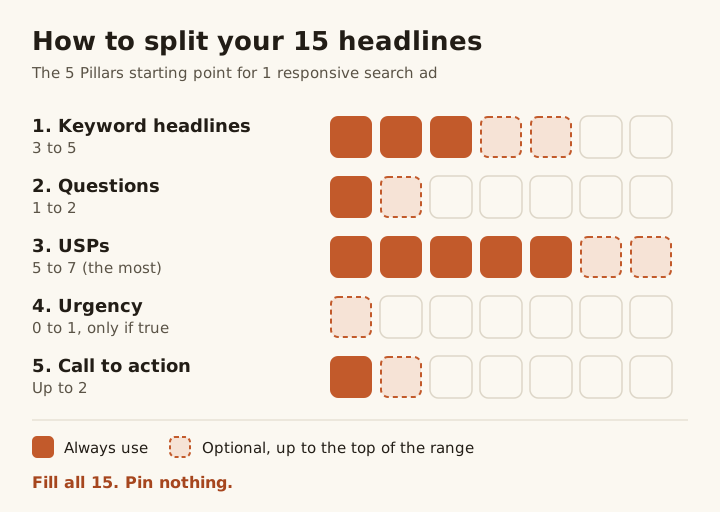
Mix short headlines of around 15 to 20 characters with longer ones up to the 30 limit. Google rarely shows two 30-character headlines side by side. A bank of shorter ones gives it far more combinations to build.
Then leave every headline unpinned. Pinning cuts the combinations Google can test and usually drags Ad Strength down. Write each headline so it makes sense in any position.
A worked example: all 15 headlines
Here's a full set for an example plumbing company. The proof figures are made up for the example. Yours must be real.
| # | Headline | Pillar | Chars |
|---|
| 1 | {KeyWord:Plumber} | Keyword | 7 |
| 2 | Top-Rated Plumber | Keyword | 17 |
| 3 | #1 Plumbing Company | Keyword | 19 |
| 4 | {LOCATION(City):Local} Plumber | Keyword | 13 |
| 5 | Looking For A Plumber? | Question | 22 |
| 6 | Need A Plumber Fast? | Question | 20 |
| 7 | Rated 4.9 By 300+ Customers | USP | 27 |
| 8 | 20+ Years Experience | USP | 20 |
| 9 | Licensed & Insured | USP | 18 |
| 10 | Fixed Prices, No Hidden Fees | USP | 28 |
| 11 | Family-Run Since 2004 | USP | 21 |
| 12 | Upfront Quotes | USP | 14 |
| 13 | With You In 30 Mins | Urgency | 19 |
| 14 | Get A Free Quote | Call to action | 16 |
| 15 | Call Now | Call to action | 8 |
A note on the insertion headlines. The code in curly brackets doesn't count toward the 30 characters. The default text does. So {LOCATION(City):Local} Plumber counts as "Local Plumber", which is 13 characters.
What about the descriptions?
You get 4 descriptions of up to 90 characters. Don't write them as flowing sentences. Treat each one as 2 or 3 short, headline-style snippets that use every character.
- Open description 1 with the question pillar, for example
Looking For {KeyWord:A Plumber}?
- Pack in your strongest USPs.
- End at least 2 of the 4 with a call to action.
Here are all 4 for the same plumbing company, built from the headlines above:
| # | Description | Chars |
|---|
| 1 | Looking For A Plumber? Rated 4.9 By 300+ Customers. Get A Free Quote Today. | 75 |
| 2 | Licensed & Insured Plumbers. Fixed Prices, No Hidden Fees. Call Now For Same-Day Help. | 86 |
| 3 | Family-Run Since 2004. 20+ Years Experience. Upfront Quotes Before Any Work Starts. | 83 |
| 4 | Need A Plumber Fast? We Can Be With You In 30 Mins. Book Online Today. | 70 |
The 5 mistakes I see most
- Leaving headline slots empty. Every empty slot is a combination Google can't test.
- A rating with no review count. "4.9 stars" means little until you say how many people gave it.
- All headlines at full length. Google rarely fits 2 of them side by side, so you get fewer combinations.
- Pinning headlines. It feels like control, but it removes the testing that makes responsive search ads work.
- Made-up proof or fake urgency. It might win a click. It loses the customer when they find out.
Cheat sheet: the 5 Pillars
Match it, Ask it, Prove it, Hurry it, Close it.
- Match it. 3 to 5 keyword headlines, including 1 keyword insertion and 1 location insertion.
- Ask it. 1 or 2 question headlines.
- Prove it. 5 to 7 USP headlines with real proof. Always rating plus review count.
- Hurry it. 0 or 1 urgency headline, only if it's true.
- Close it. Short calls to action. 2 at most.
Fill all 15. Mix short and long. Pin nothing. Descriptions: 2 or 3 short snippets each, and end at least 2 of the 4 with a call to action.
Questions people ask about the 5 Pillars
What are the 5 pillars of Google Ads copy?
The 5 Pillars of Google Ads copy is Ben Allen's framework for writing responsive search ads. The 5 pillars are keyword headlines, questions, USPs backed by real proof, urgency and a short call to action. Together they give Google enough variety to build ads that match the search and give people a reason to click.
Which pillar matters most?
USPs. Real proof like a star rating with the review count, years in business or customers served is what makes someone pick your ad over the one above it. Give USPs the most headlines, alongside keyword headlines.
How many keyword headlines should a responsive search ad have?
3 to 5, including 1 keyword insertion headline and 1 location insertion headline. Most of the rest go to USPs.
How many call to action headlines should a responsive search ad have?
No more than 2. Keep them short, like Get A Free Quote or Call Now, so they can close any combination Google shows.
Should I pin my headlines?
No. Pinning cuts the number of combinations Google can test and usually lowers Ad Strength. Write every headline so it works in any position and leave them all unpinned.
Does the 5 Pillars method help Ad Strength?
It covers what Ad Strength looks for in your headlines: all 15 filled, each one saying something different, your keywords in the copy and nothing pinned. Ad Strength scores the copy, not the results, so judge the ad on leads too.
Want help writing yours?
Ad copy is one of the sessions in my Google Ads coaching. We write your headlines together, live in your own account, using these 5 pillars. If you run an agency, the same framework is part of my coaching for agencies. And once the ads are right, a matched landing page is the next thing to get right.

About the author
Ben Allen is a Google Ads coach and Google Partner with 8+ years in the platform and $10M+ in ad spend managed. He created the 5 Pillars framework and uses it on every ad he writes for businesses and agencies in the UK and US.